Context
A garden that deserves a running record.
In spring 2023 the Friends commissioned an ecologist to survey breeding birds and butterflies across the gardens and the Woodland Dell. It is an excellent piece of work and the site's firmest baseline, capturing one spring in detail.
What a baseline invites is a way to keep watching. The gardens are a Site of Importance for Nature Conservation with several hundred people walking through each week, most of them carrying a camera in their pocket, many of them curious about what they are looking at.
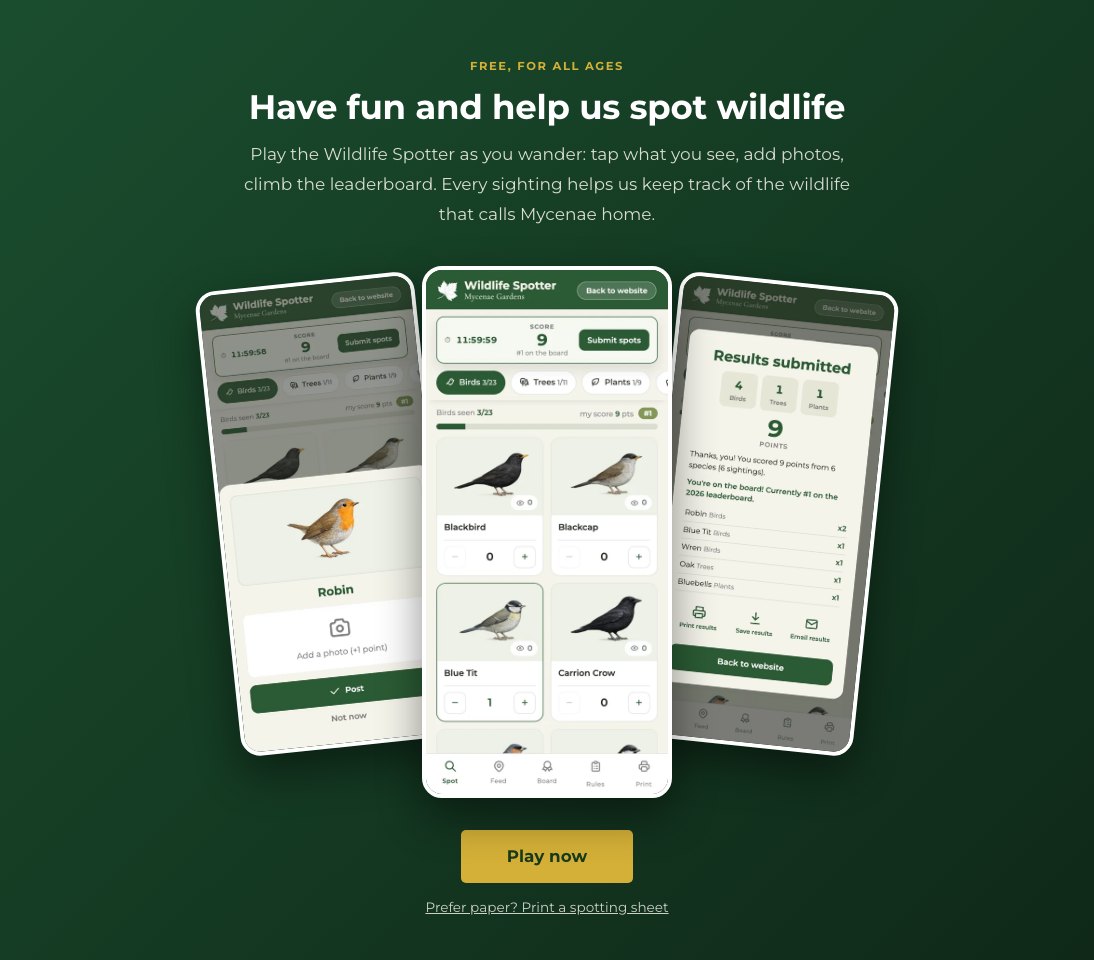
The Wildlife Spotter turns that curiosity into a continuous record. Not a game with a nature theme: a recording scheme with a game's manners.
The strategic play
Crowd-sourcing as a data strategy.
Every visitor is a potential recorder. Crowd-sourcing will never replace a professional transect, and it is not meant to. What it adds is continuity: which species are seen, where in the gardens, in which month, by how many different people, season after season.
That does three jobs at once. It builds a running picture of what is using the site, including arrivals and movements between seasons that a single survey cannot show. It gives funders evidence drawn from real observations rather than estimates. And it gives a visitor a reason to look closely at a hedge, which is what turns a passer-by into a supporter.
The competitive layer is deliberate and small: a shared leaderboard, a point for a sighting, a bonus for saying where in the gardens you saw it, another for attaching a photograph. Those two bonuses exist because location and evidence are exactly what make a record useful later.
Design
One hand, outdoors, patchy signal.
A session runs for twelve hours and lives on the device, so a family can start at the gate and submit at the end with no account, no login and no email address. A nickname is the only identity, and the privacy notice asks people not to use their full name.
Nothing is logged until you press Post, so tapping a species to read about it costs nothing. Submissions made where the signal drops queue in an outbox and retry themselves. The score updates only when the points card lands on it, because the animation is the feedback.
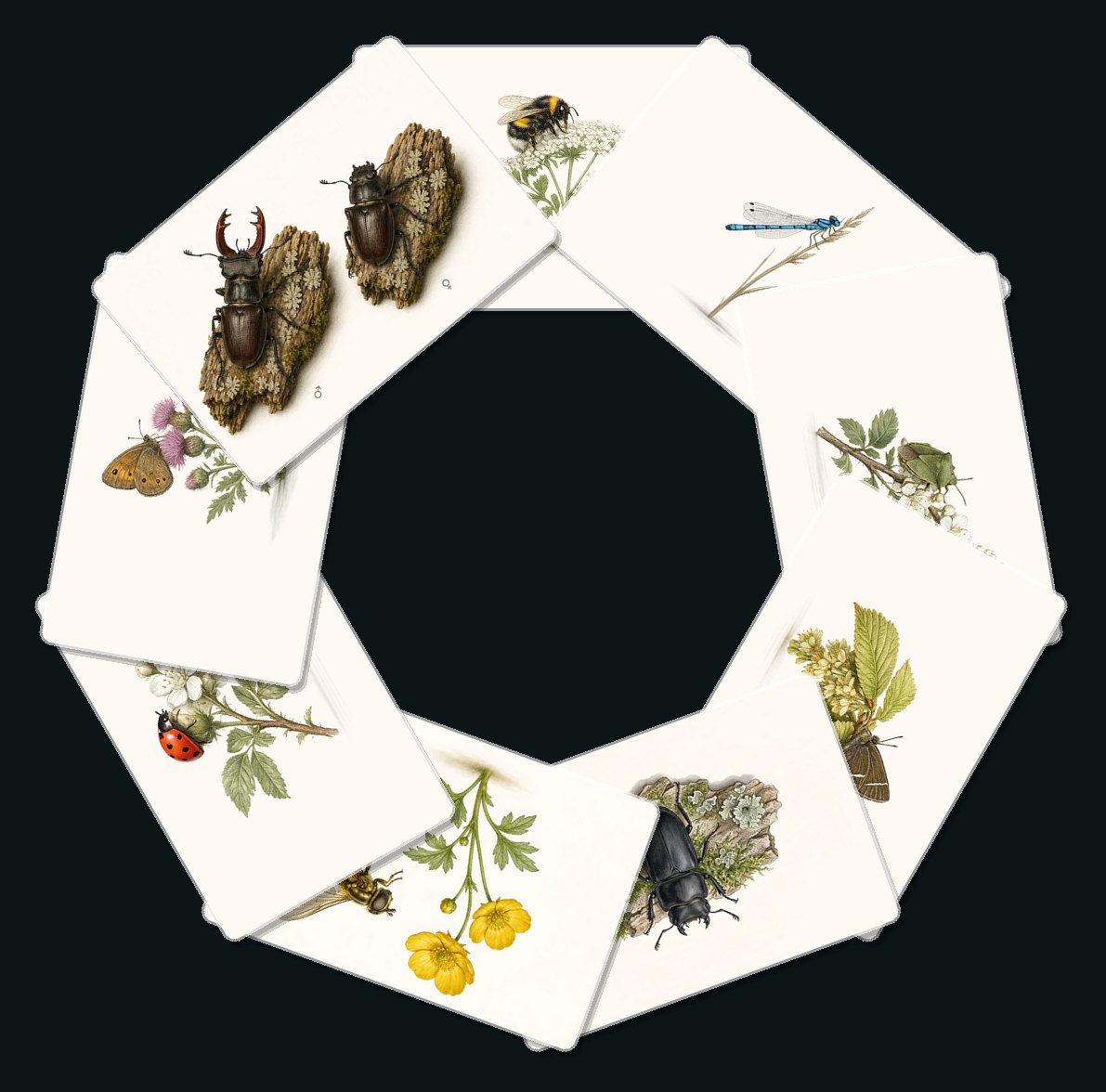
For anyone without a phone, the same species list prints as a three page A4 sheet with tick boxes, birds through to plants, fully illustrated. That is what most children use on the day.


Architecture
Nothing anyone has to run.
The same principle governs this as the website: it has to be handed over. So the leaderboard is not a bespoke service. A serverless function validates and sanitises a submission and writes it into the same content system the committee already uses, where moderating an entry is deleting a row in an interface they know.
Species live there too. Adding a bird, tree, plant or insect is a form a committee member fills in, and it appears on the website, in the game and on the printable sheet at the next build. Moving seventy eight species into that system was verified by building the pages before and after and comparing them, so the change was provably invisible to visitors.
Honesty about the data
Clear about what it is.
Records are unverified: identification is whatever a visitor tapped, under a nickname. Counts cap at five per sighting, timing is per session rather than per sighting, and two people logging the same robin are two records.
So it is presence and effort data, and the committee has that in writing. Described that way it is strong evidence of engagement and of what is being seen where. Described as a survey it would overstate itself, and on a site that publishes a professional ecologist's report one click away, precision about this is worth more than a bigger claim.
Outcome
Live, illustrated, and in pockets.
Launched with the website in August 2026, days before the group's biggest event of the year, with every one of the seventy eight species illustrated. Print sheets went to the stall, the game went into people's pockets, and the records go into the group's own archive where anyone on the committee can read them.
Since launch, the records pipeline has hardened. Every entry now carries its source, game or competition form, so the committee can see where each record came from. Their admin gained dedicated views for reviewing game entries alongside competition photographs. And the site's content dataset exports weekly into version control, so the evidence this game exists to gather outlives any platform it happens to sit on.
Reflection
Play is the cheapest bridge to evidence.
The interesting part was never the game loop. It was noticing that a community group's scarcest asset is evidence, that its most abundant asset is people walking past, and that a playful interface is the cheapest bridge between the two.
It also had to be built so that nobody inherits a maintenance burden. A recording scheme that needs a developer is a recording scheme that eventually stops.